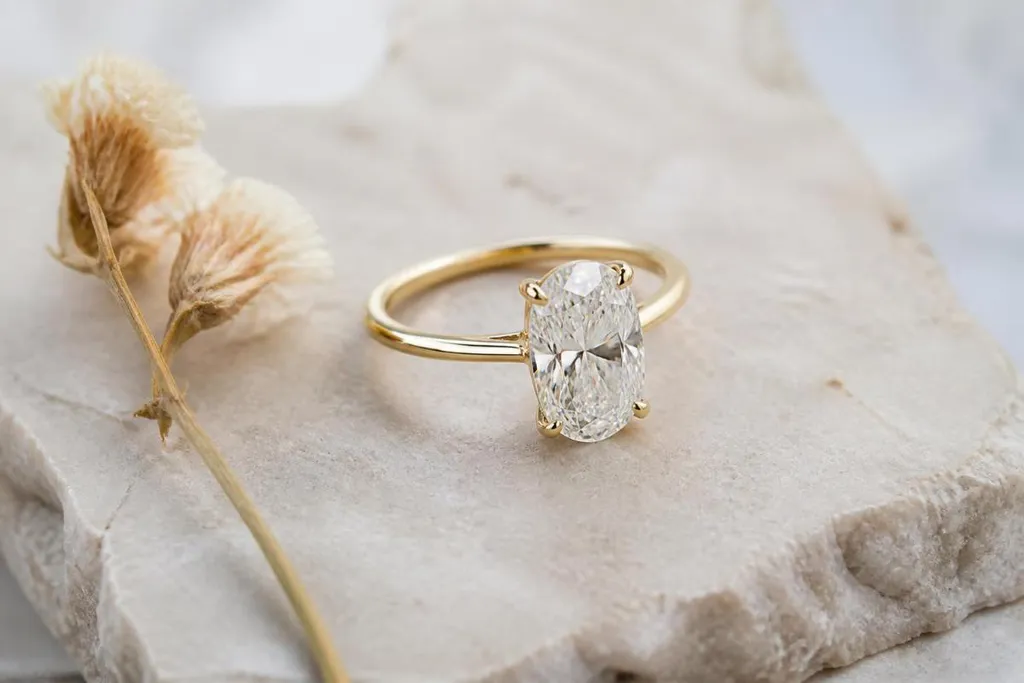
The elongated cushion cut takes the softness of a traditional cushion diamond and gives it a noticeably more slender silhouette. Rounded corners preserve the shape's romantic character, while additional length creates a contemporary look and greater visual coverage along the finger. Yet not every elongated cushion looks alike, and subtle differences in proportion can dramatically change the finished ring.
For this reason, exploring beautiful lab diamond elongated cushion cut rings is about more than choosing a preferred carat weight. Length-to-width ratio, facet pattern, actual dimensions and setting style all influence whether a diamond appears softly rectangular, distinctly elongated or somewhere between the two. Understanding those differences makes it easier to choose proportions that feel intentional on the hand.
What Makes a Cushion Diamond Elongated?
A traditional cushion cut often has proportions close to a square, distinguished by gently curved sides and rounded corners. An elongated cushion retains those features but extends the outline lengthways.
The degree of elongation is described by the diamond's length-to-width ratio, calculated by dividing its length by its width. As that figure increases, the diamond generally appears more slender.
There is no single ratio that defines the perfect elongated cushion. A modestly elongated stone can retain much of the fullness associated with a classic cushion while introducing extra length. A higher ratio creates a more obviously rectangular silhouette and can feel particularly contemporary.
The preference is largely aesthetic. Some wearers want the soft, substantial appearance of a cushion with only a hint of elongation; others specifically choose the shape because they prefer a long, elegant outline.
Why Ratio Matters More Than Carat Alone
Carat measures weight, but it does not describe how that weight is distributed. This distinction becomes especially relevant with elongated diamonds.
Two lab-grown elongated cushions of identical carat weight may have different measurements. One might carry greater depth, while another distributes more of its weight across its visible length and width. As a result, their face-up presence can differ even though the carat figure is the same. This is also why moving from a 1-carat to a 2-carat diamond should not be viewed purely as choosing something larger. A wearer may favour a 2-carat elongated cushion because its dimensions create a particular balance across longer fingers or complement a more substantial band. Someone else may deliberately choose a smaller stone with a higher length-to-width ratio because the slender outline matters more to them than overall scale.
Actual measurements, ratio and appearance on the hand therefore deserve to be considered together.
Faceting and Setting Change the Overall Character
The outline is only one part of an elongated cushion's personality. Facet arrangement affects how light moves through the stone and can produce different styles of sparkle.
Some cushions display broader, more defined flashes, while others create a busier pattern of scintillation. Certain elongated stones can also show areas of stronger contrast through the centre. Viewing the diamond under different lighting conditions is useful because a grading report cannot fully communicate these visual characteristics.
The setting then provides another layer of influence. A solitaire keeps the elongated outline clear and gives the diamond plenty of visual space. Diamond-set shoulders add brilliance along the finger, while a halo creates a broader composition around the centre stone.
A hidden halo can be particularly effective for someone who wants extra detail without interrupting the cushion's face-up silhouette. From above, the elongated shape remains dominant; from the side, smaller diamonds introduce an additional point of interest.
Consider Band Width, Metal and Daily Wear
A fine band can emphasise the scale and length of an elongated cushion, creating a delicate contrast around the centre diamond. Larger stones, however, may also look beautifully balanced against a slightly more substantial band.
Metal choice shifts the aesthetic further. Platinum and white gold create a crisp, cool setting, while yellow gold adds warmth and stronger contrast. Rose gold can complement the rounded corners and soften the overall composition. Practicality should remain part of the decision. Setting height, claw placement and the gallery all affect how the ring feels during daily wear and how easily it pairs with a future wedding band.
Final Thought
Elongated cushion lab diamond rings are appealing because they offer more than a simple variation on the classic cushion. Small changes in length-to-width ratio can transform the shape from softly rectangular to distinctly slender, giving buyers considerable control over the finished appearance.
Rather than relying on carat weight alone, compare ratios, dimensions, faceting and setting proportions. The right elongated cushion is the one where those elements work together, creating a ring that looks naturally balanced rather than merely impressive on paper.